W.D. Gaster and Wingdings: The Undertale Connection Explained
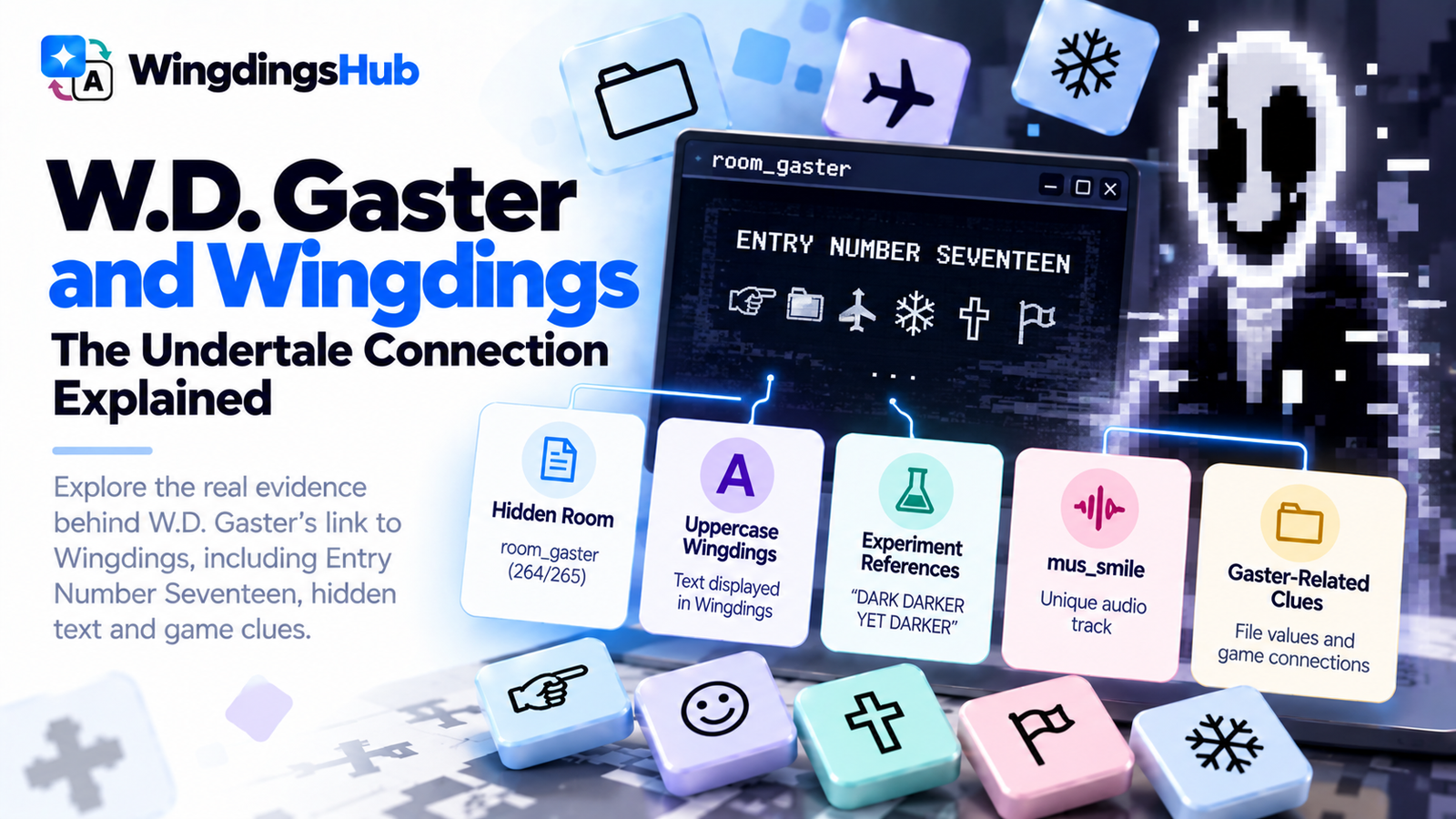
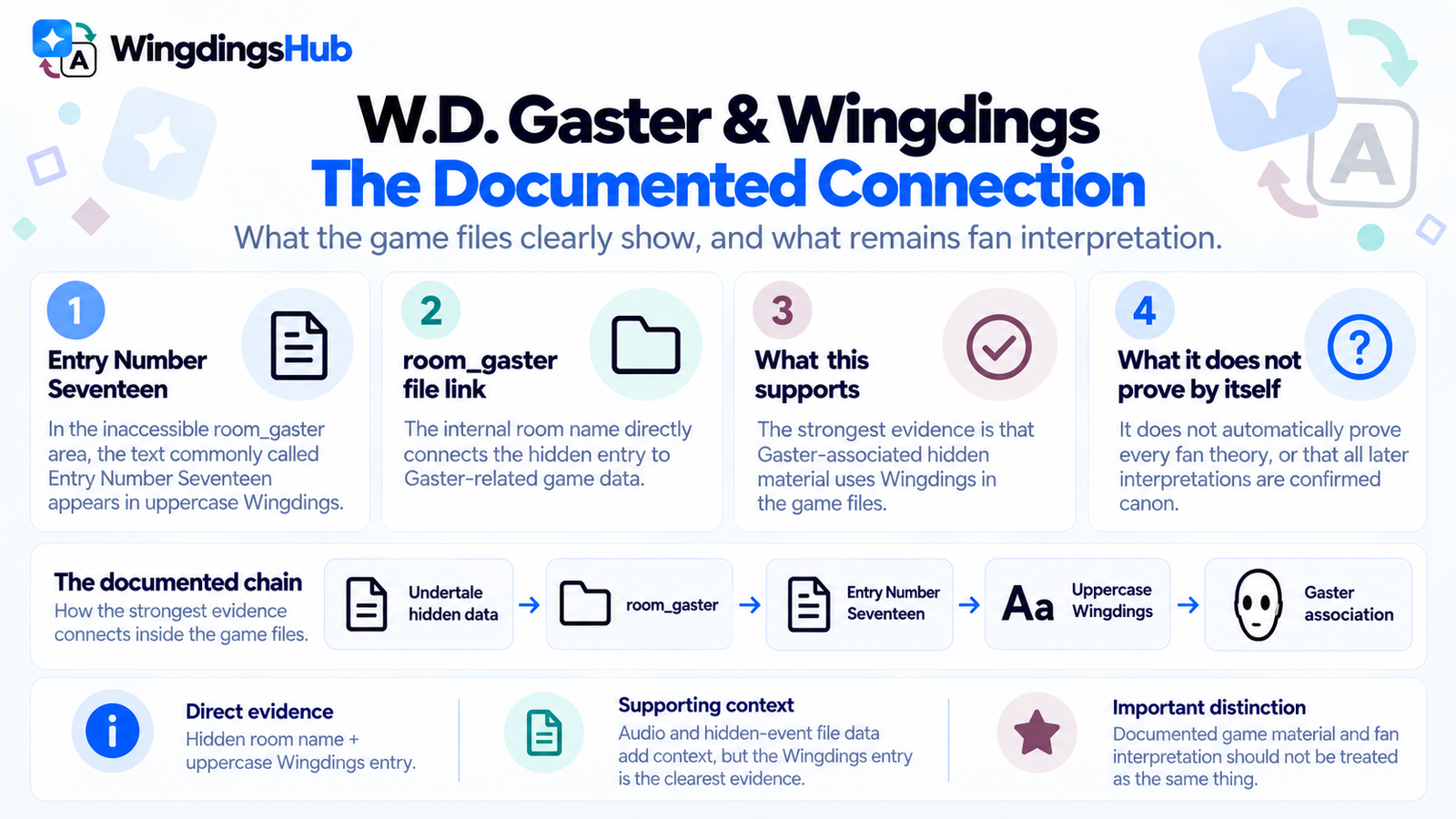
W.D. Gaster’s association with Wingdings comes from a real piece of Undertale content, not simply from fandom naming conventions. An inaccessible game room internally called room_gaster displays Entry Number Seventeen in an uppercase Wingdings typeface. Several other details connect Gaster with unusual typography, hidden game events, and recurring language about darkness and experimentation.
The evidence becomes less certain when it reaches some of the character’s most famous fan interpretations. The game identifies Gaster as a former Royal Scientist, while the Mystery Man sprite and the River Person’s “man who speaks in hands” line remain open to interpretation.
Separating those layers makes the Wingdings connection much easier to understand.
How Strong Is Each Gaster–Wingdings Connection?
| Claim | Evidence Level | What Supports It |
|---|---|---|
| Entry Number Seventeen uses Wingdings | Direct | The inaccessible room_gaster displays its text in an uppercase Wingdings-style font. |
| Entry Number Seventeen is closely associated with Gaster | Very strong | The internal room name is room_gaster, and the entry uses several file-level values associated with Gaster. |
| “W.D.” refers to Wingdings | Strong interpretation | It fits the Wingdings text and the font-name pattern used for Sans and Papyrus, but the initials are never expanded in dialogue. |
| The River Person’s “man who speaks in hands” is Gaster | Supported interpretation | Wingdings prominently contains hand symbols, and Gaster-associated text uses the typeface. |
| Mystery Man is Gaster | Fan interpretation | The encounter shares several Gaster-related motifs, but the sprite is internally named mysteryman and is never identified as Gaster in the game. |
| Gaster has an active role in Deltarune | Unresolved | Deltarune contains numerous Gaster-like allusions, while the released chapters have yet to confirm an appearance by him. |
Entry Number Seventeen Is the Clearest Wingdings Evidence
The strongest connection appears in an inaccessible area of Undertale commonly identified by its internal name, room_gaster.
The room is numbered 264 in most versions of the game and 265 in the Xbox version. It consists of a dark screen, shaking white text, and an unsettling audio track internally named mus_smile. The displayed writing uses a pixelated Wingdings font.
The text identifies itself as “ENTRY NUMBER SEVENTEEN”. Once the Wingdings glyphs are read back into their mapped letters, the entry describes increasing darkness, deepening shadows, negative photon readings, and an upcoming experiment. Among its best-known lines are:
- “DARK DARKER YET DARKER”
- “PHOTON READINGS NEGATIVE”
- “VERY VERY INTERESTING”
The entry ends by addressing two other people, implying that the speaker is communicating with at least two participants or observers. Their identities are not established by the entry itself.
The room cannot normally be reached during an ordinary playthrough. It is accessed through methods such as SAVE manipulation or debug access, which helped make it one of the game’s most discussed hidden discoveries.
Why Entry Number Seventeen Is Associated With Gaster
The internal room name provides the most obvious clue, but it is part of a larger group of details.
Gaster appears in Undertale‘s hidden material as the Royal Scientist who held the position before Alphys. The Gaster followers describe him as exceptionally brilliant and connect him with the creation of the CORE. They also describe an experiment-related fate in fragmented terms: his life was cut short, he fell into his creation, vanished without a trace, and was shattered across time and space.
Entry Number Seventeen fits that scientific characterization. Its speaker discusses an experiment and reports a measurement—negative photon readings—rather than delivering ordinary character dialogue.
There are file-level links as well. The text’s typer value is 666, and repeating sixes occur elsewhere in unused Gaster-related data. Gaster-associated fun-value events also cluster in the 60s.
None of these clues depends on interpreting the shapes of individual Wingdings symbols. The connection comes from where the text appears, how the room is named internally, how the entry is presented, and the broader Gaster material stored in the game.
What the Gaster Followers Actually Establish
Three rare grayscale NPCs provide most of Undertale‘s direct information about Gaster. Their appearances depend on the game’s hidden fun value.
| Event | Fun Value | Relevant Information |
|---|---|---|
| Gaster Follower 2 | 61 |
Describes Gaster vanishing and being shattered across time and space. |
| Gaster Follower 1 | 62 |
Connects Gaster with the CORE and says he fell into his creation. |
| Gaster Follower 3 | 63 |
Calls the previous scientist Dr. Gaster, describes his brilliance, and refers to an experiment going wrong. |
| Sound Test room | 65 |
Can provide access to a track titled Gaster’s Theme. |
| Fake hallway / Mystery Man event | 66 |
Can lead to the rare Mystery Man encounter. |
The follower dialogue establishes a surprisingly substantial outline for such a hidden character: Gaster existed, served as Royal Scientist before Alphys, worked on the CORE, and suffered an extraordinary fate connected with his work.
The strange delivery is equally important to his reputation. The information is scattered across rare events rather than presented through the game’s main story, encouraging players to assemble the character from fragments.
Does “W.D.” Stand for Wingdings?
Wingdings is the leading explanation for the initials, but Undertale never spells them out.
The theory fits an established naming pattern. Sans is named after Comic Sans and speaks in that typeface. Papyrus is named after the Papyrus font and normally speaks in it. Gaster-associated Entry Number Seventeen uses Wingdings, making W.D. → Wingdings an unusually natural reading.
The initials and the font also line up visually with the common spelling of “Wingdings,” often written as “Wing Dings” when people are discussing the name connection.
There are alternative interpretations of the name in fan analysis, and the typography connection remains the strongest basis for reading the initials as Wingdings.
The “Man Who Speaks in Hands” Clue
The River Person can deliver the warning:
“Beware of the man who speaks in hands.”
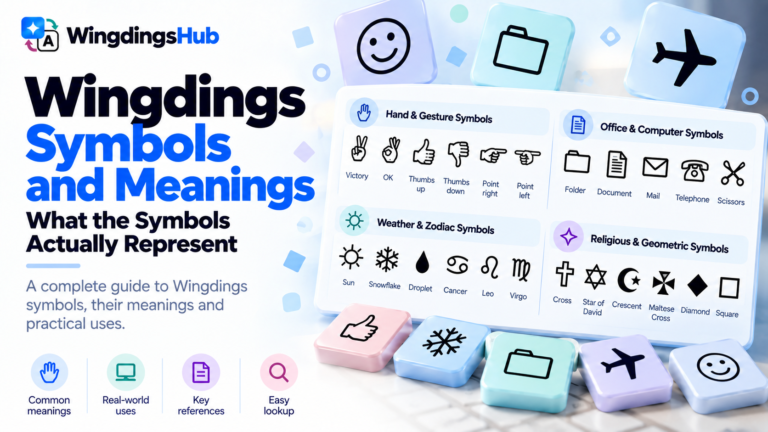
It became associated with Gaster because Wingdings contains an unusually prominent collection of hand glyphs. In the original font, uppercase positions include pointing hands, thumbs, a victory gesture, and an open hand.
That makes “speaks in hands” a plausible description of someone whose dialogue appears in Wingdings.
The surrounding evidence adds to the association: Gaster is male, his hidden entry uses Wingdings, and his presence is deliberately obscured throughout the game. The River Person never names him in this line, leaving the identification inferential.
For the actual hand glyphs used by Wingdings, Wingdings Symbols and Meanings identifies the main gestures and their ordinary visual roles.
Mystery Man and Gaster Are Separate Questions
The distorted monochrome figure commonly used in Gaster fan art comes from another rare event. If the appropriate fun value is set to 66, a false hallway can appear in Waterfall, with a further chance of reaching the room containing the figure.
Its internal name is mysteryman. Interacting with it causes the figure to disappear, accompanied by the same disappearance sound used by one of the Gaster followers.
Those details make the encounter relevant to Gaster discussions, especially because fun value 66 sits alongside several other Gaster-associated events in the 60s. The game, however, gives the figure no dialogue or displayed name.
The familiar white face with dark eye-like openings has therefore become the dominant visual representation of Gaster through fandom, while the character’s confirmed in-game appearance remains undefined.
This distinction is particularly useful when researching Wingdings. The typeface connection comes from Entry Number Seventeen regardless of which sprite, if any, represents Gaster physically.
Gaster’s Theme Adds Another “Him” Connection
A rare Sound Test room can appear when the fun value is 65 and the necessary gameplay condition is met. Among the tracks available there is Gaster’s Theme.
Inside the game files, the track is named mus_st_him.
The word “him” later became significant outside Undertale. Before Deltarune was publicly released, an image on the official deltarune.com website used the filename him.png. Its earliest known version displayed an excerpt from Entry Number Seventeen in Wingdings.
That shared naming is one of several reasons the Gaster discussion eventually expanded beyond Undertale.
Wingdings Appeared on the Deltarune Website Before Release
In December 2015, years before Deltarune Chapter 1 became publicly available, deltarune.com displayed a dark, low-contrast image named him.png.
The image used Wingdings to reproduce the Entry Number Seventeen phrase about the next experiment being “very very interesting.”
A later version of the same image changed the message. It still used Wingdings, but now presented an early form of the Deltarune prophecy concerning three heroes and the Angel’s Heaven.
This sequence matters because it creates a documented bridge between the Gaster-associated material in Undertale and Deltarune‘s development. Wingdings was used to move from a quotation of Entry Number Seventeen directly into material that later became central to Deltarune.
Gaster Allusions in Deltarune
Deltarune has continued to reuse several motifs associated with Gaster, while keeping their exact relationship unresolved.
The opening sequence is one of the clearest examples. Its music is titled ANOTHER HIM, echoing the mus_st_him filename of Gaster’s Theme. Entering GASTER as certain names during the introduction causes the sequence to terminate and return to the chapter intro.
Language from Entry Number Seventeen also resurfaces. Seam uses “darker, yet darker” in Chapter 1, and by Chapter 5 uses the distinctive construction “very, very, interesting” while discussing the Shadow Crystals. Related darkness imagery and the mus_smile sound from room_gaster also recur elsewhere in Deltarune.
As of Chapter 5, released June 24, 2026, W.D. Gaster has no confirmed on-screen appearance in Deltarune. The released game instead continues to build a network of references that resemble his Undertale material.
Which Gaster Claims Go Beyond the Evidence?
Some ideas have become so familiar in fan art and theory discussions that they can sound like established character facts.
- Gaster’s appearance: the Mystery Man design is widely used for him, while the game has not formally identified that figure as Gaster.
- His initials: Wingdings is a persuasive explanation for “W.D.”, but the initials remain unexpanded in the game.
- His relationship to Sans and Papyrus: the shared font motif encourages theories about a family or species connection. No direct family relationship has been established.
- The two people addressed in Entry Number Seventeen: many identities have been proposed; the entry itself leaves them unnamed.
- The subject of the experiment: the darkness and negative photon readings invite comparisons with Deltarune, but the entry does not identify the experiment in explicit terms.
- His current condition: the followers describe being shattered across time and space and imply an unusual continuing presence, but the mechanics of that state remain unexplained.
These gaps are a large part of Gaster’s appeal. The game provides enough structure for theories to connect real clues, while withholding the details needed to settle many of them.
Reading Entry Number Seventeen as Wingdings
Entry Number Seventeen uses ordinary character positions displayed through a Wingdings-style typeface. Reading it follows the glyphs back to the characters at their mapped positions.
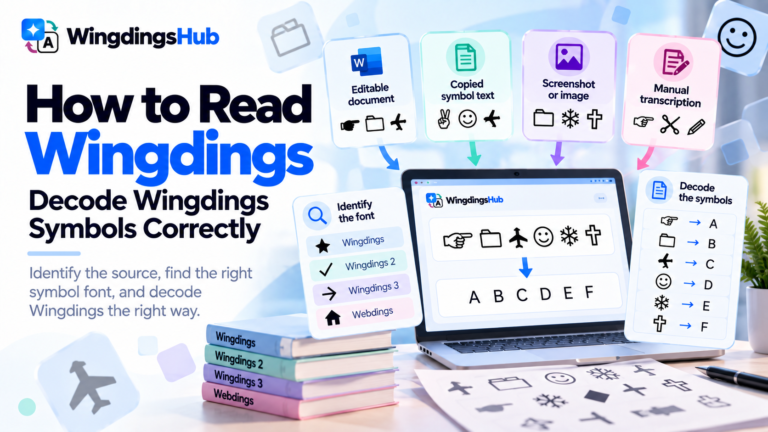
That is the same basic process used for other font-formatted Wingdings text. The How to Read Wingdings guide covers manual identification and uncertain sources, while the Wingdings Translator can convert supported Wingdings-style symbol strings directly.